Simulation code and results
Human-carried indirect sensing
A person carries a smartwatch and a smartphone across a flexible deck. The model solves the person and the deck together and records what the devices measure.
| Paper | Babazade and Lüleci, under review |
|---|---|
| Deck | OpenSeesPy, simply supported |
| Person | 15 DOF, walking or standing |
| Devices | triaxial, wrist and hip |
| Authors | J. Babazade and F. Lüleci, LSU |
One crossing of the deck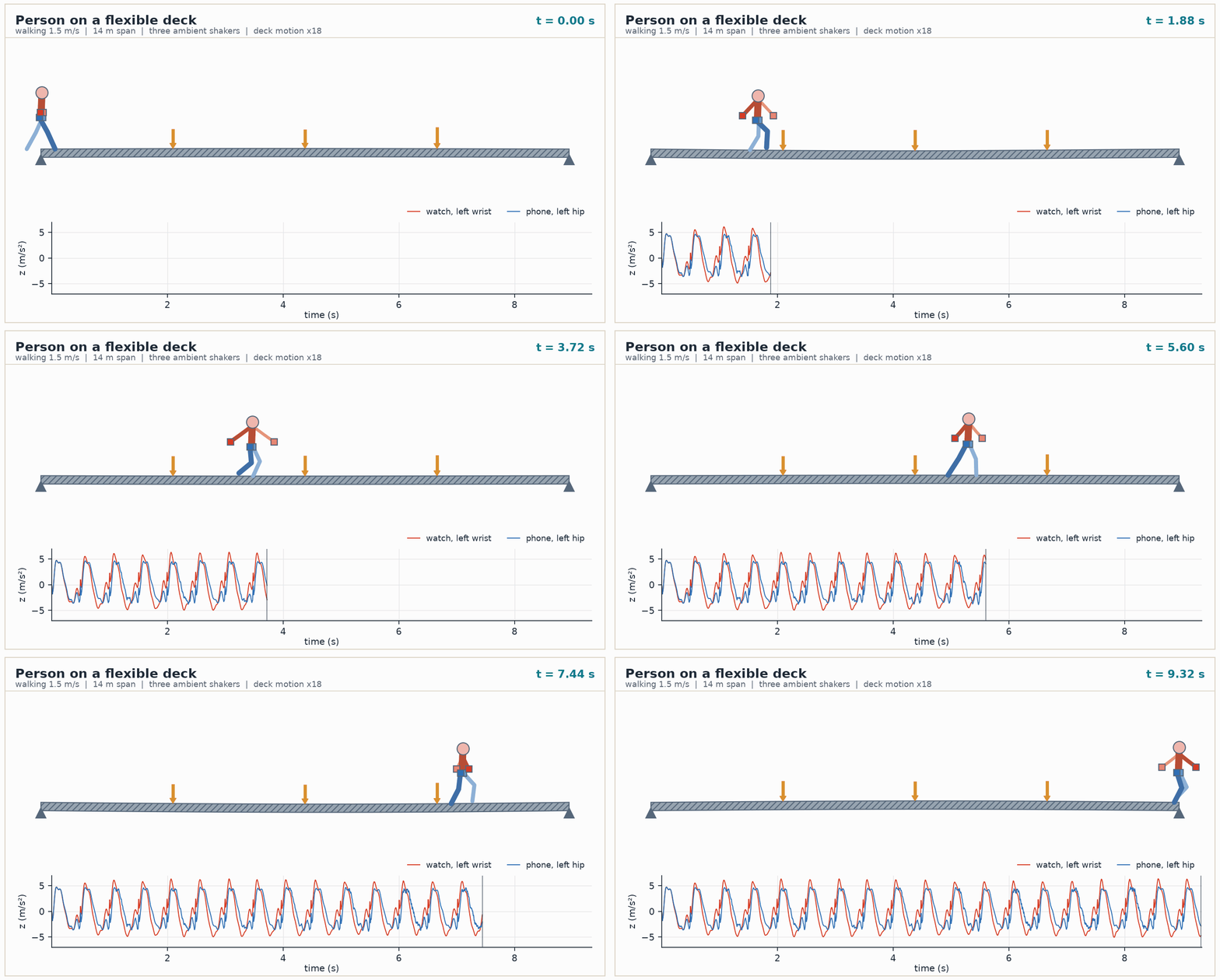
1Parameter explorer
Ten parameters, every pair already simulated. Sweep one and compare the deck with the two devices. Click a deck peak to see its mode shape and whether each device found it. Gait lines and the observability index of every mode are shown with it.
2Animations
The baseline deck. Deck motion is exaggerated, the person is to scale.
3The model
- Deck
- Any flexible deck a person walks on: a floor slab, a footbridge, a walkway. Baseline is a 14 m concrete slab, 3 m wide, 0.2 m thick.
- Person
- Five masses in three directions. Walking force, step timing and arm swing are included.
- Coupling
- Person and deck are solved together in every time step.
- Devices
- A watch on each wrist and a phone on each hip, with sensor noise.
- Excitation
- Three ambient shakers on the deck, plus the person.
4Code
Source, data and run instructions: github.com/covdetbaba/human-carried-indirect-sensing